AI ROI Is Cost Per Accepted Task, Not Token Price
A practical AI ROI scorecard for SaaS teams: measure accepted outputs, review time, direct cost, and repeatability before scaling an agent workflow.
Last updated
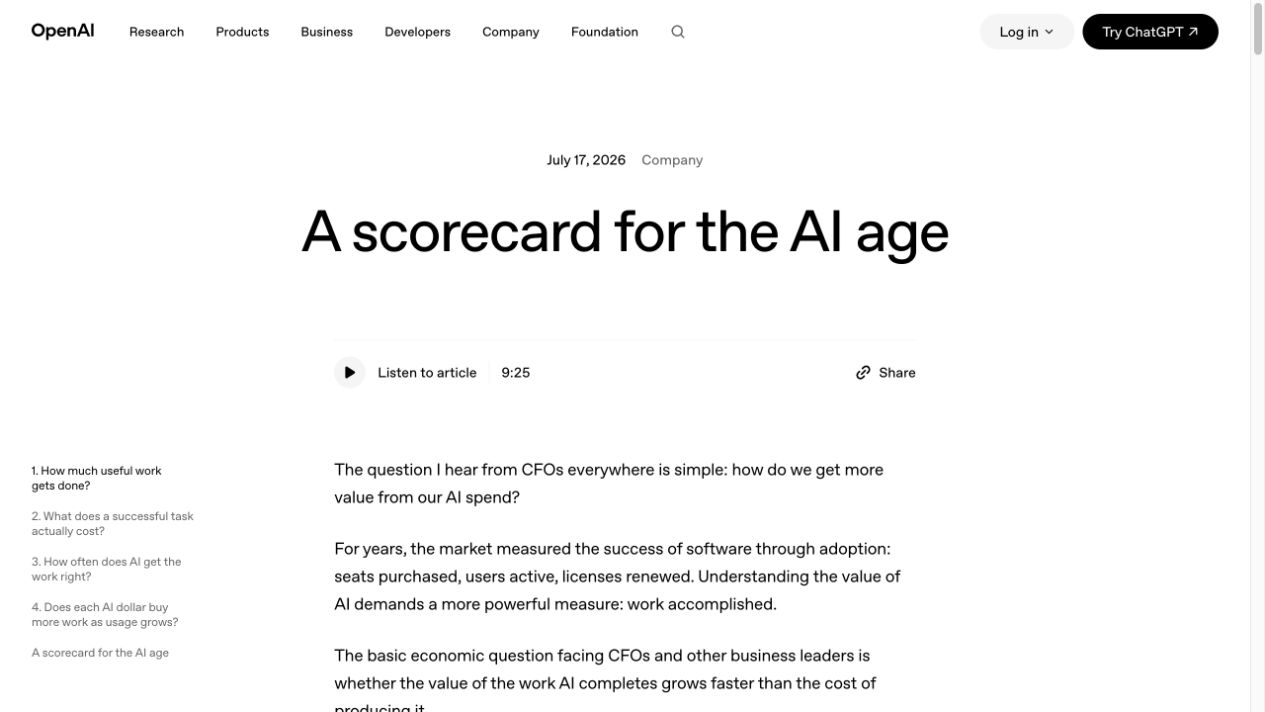
AI budget conversations often start in the wrong place. Teams compare model prices, count seats, or point to a dashboard full of messages. Those are usage signals. They do not tell you whether useful work is getting done.
OpenAI's July 2026 AI scorecard makes the same shift in framing: evaluate useful work, cost per successful task, dependability, and return on compute. It is a useful prompt for any team, even if it does not use OpenAI products. The important word is successful.
An AI workflow that produces 100 drafts is not valuable because it produced 100 drafts. It is valuable when a defined number of those drafts are accepted, safely used, or converted into an outcome with less total effort than the old process.
Start by defining "accepted" before you measure anything
The cleanest way to get a flattering AI ROI number is to count attempts. The cleanest way to get a useful one is to define an acceptance rule before the first run.
For a customer-support draft, acceptance might mean the reply follows the current policy, cites the correct account facts, needs no more than one small edit, and is sent within the intended service window. For a coding task, it might mean the change passes tests, respects the repository rules, receives review approval, and does not cause a follow-up incident. For a sales-research task, it might mean the record is complete enough for a rep to act without re-researching it.
The rule should be binary enough to apply repeatedly, but not so narrow that it rewards shallow output. "The model returned text" is not an acceptance rule. "A reviewer approved the response using the current policy and spent under three minutes correcting it" is closer.
A scorecard that a product team can actually run
Use one fixed task set. It should include ordinary work, edge cases, and a few tasks where the right answer is to refuse, escalate, or ask for more data. Do not replace the set every time a new model looks better.
For each attempt, record these fields:
| Field | What it reveals | Common mistake |
|---|---|---|
| Task type and risk | Whether performance varies by job | Combining easy and risky work into one average |
| Accepted or rejected | The real pass rate | Counting a draft as a pass before review |
| Review minutes | Hidden human cost | Treating reviewer time as free |
| Direct cost | Model, tools, and infrastructure spend | Looking only at token price |
| Failure reason | What to repair next | Calling every failure a model problem |
| Reuse or downstream result | Whether the output had durable value | Stopping measurement at generation |
This gives you a simple calculation:
Cost per accepted task = (direct AI cost + review cost + failure recovery cost) / accepted tasks
The formula is not a universal accounting standard. It is a forcing function. It prevents a team from celebrating a lower per-token price while ignoring the reviewer who spends twelve minutes repairing each result.
The scorecard changes the conversation from model choice to workflow design
Suppose Workflow A costs $0.08 per attempt and succeeds 55% of the time after six minutes of review. Workflow B costs $0.24 per attempt and succeeds 82% of the time after one minute of review. A token-cost comparison says A is cheaper. A successful-task calculation may show the opposite once human time and retries are included.
That does not automatically mean B is the winner. The reviewer might be able to batch-edit Workflow A. Workflow B might fail dangerously on rare tasks. One model may be unavailable in the region where the team operates. The point is to make those trade-offs visible instead of burying them under an average cost number.
OpenAI's agentic-investment guidance describes useful work per dollar and dependability as central measures. That is more helpful than a generic promise of "productivity." A useful workflow should have a job boundary, a reliable acceptance condition, and an owner who can improve the surrounding context when it fails.
Separate four kinds of failure
Teams lose time when every bad answer becomes a prompt rewrite. Most failures belong to a different layer.
- Input failure: the task lacked current source material, permissions, customer facts, or a clear instruction.
- Execution failure: a tool call, retrieval step, model output, or integration did not complete.
- Acceptance failure: the output was plausible but did not meet the quality, policy, or format rule.
- Economic failure: the output was acceptable but required too much review, delay, or spend to scale.
This is where Context Engineering: The Layer Between Prompts and Reliable AI Products becomes operational rather than theoretical. If a workflow fails because the agent never received the current policy, a better benchmark score will not fix it. If it fails because a reviewer cannot quickly see its sources, a more expensive model may only make the issue harder to notice.
Build a baseline before you automate the whole process
Pick one recurring task. Create 20 to 50 representative examples from real work, with sensitive details removed where necessary. Label the expected result, the allowed sources, and the conditions under which the task should be escalated to a person.
Then run the current manual process and the AI-assisted process against the same set. Record elapsed time, reviewer time, direct spend, acceptance, and reason for rejection. Keep the wording and the evaluation rules stable for one measurement cycle.
This baseline has three benefits:
- It gives the team a way to compare new models or tools without changing the goalposts.
- It exposes tasks that should remain human-owned rather than being forced into automation.
- It identifies the most valuable next improvement: better retrieval, a smaller task boundary, clearer approval rules, or a different tool.
The baseline does not need a giant evaluation platform. A spreadsheet and a disciplined review ritual can outperform an impressive dashboard with no consistent definition of success.
Set a stop rule before enthusiasm turns into spend
Every pilot needs a condition that stops expansion. Examples:
- fewer than 70% of low-risk tasks are accepted after a defined iteration window;
- review time remains above the manual baseline;
- a high-severity failure appears in a task that was supposed to be safe;
- direct cost rises faster than accepted output;
- the team cannot explain the most common failure reason.
The stop rule is not an admission that AI failed. It protects the team from continuing a project because the demo looked convincing. A workflow can be promising and still be wrong for production today.
Where small SaaS teams usually find the first return
The best early use cases are repetitive but not fully autonomous: classifying inbound requests, assembling research from approved sources, drafting a response for review, checking structured data, or preparing a handoff. These tasks have a measurable before-and-after and a person who can catch mistakes.
The worst early use cases are broad, unbounded mandates such as "run our growth strategy" or "handle every support issue." They create a large surface area for hidden work, weak attribution, and expensive exceptions. The team learns less because it cannot say which part of the workflow created the result.
That distinction is also useful when choosing what to build. AI Tool Ideas: Find Repeated Work Worth Building Before You Build an Agent starts with repeated work; this scorecard tells you when that repeated work has earned a bigger investment.
Scale the workflow, not the excitement
An AI project has real ROI when the team can point to accepted work, lower total cost, dependable behavior, and a repeatable way to improve failures. That is more rigorous than counting prompts, but it is also kinder to the team. It makes clear when a workflow needs better context, more review, a narrower task, or a stop.
Start with one task set. Count accepted outcomes. Put review and recovery into the denominator. Expand only after the scorecard says the work is earning its place.
Related reading: Context Engineering: The Layer Between Prompts and Reliable AI Products, AI Tool Ideas: Find Repeated Work Worth Building Before You Build an Agent, and Tools.
Related insights
All insights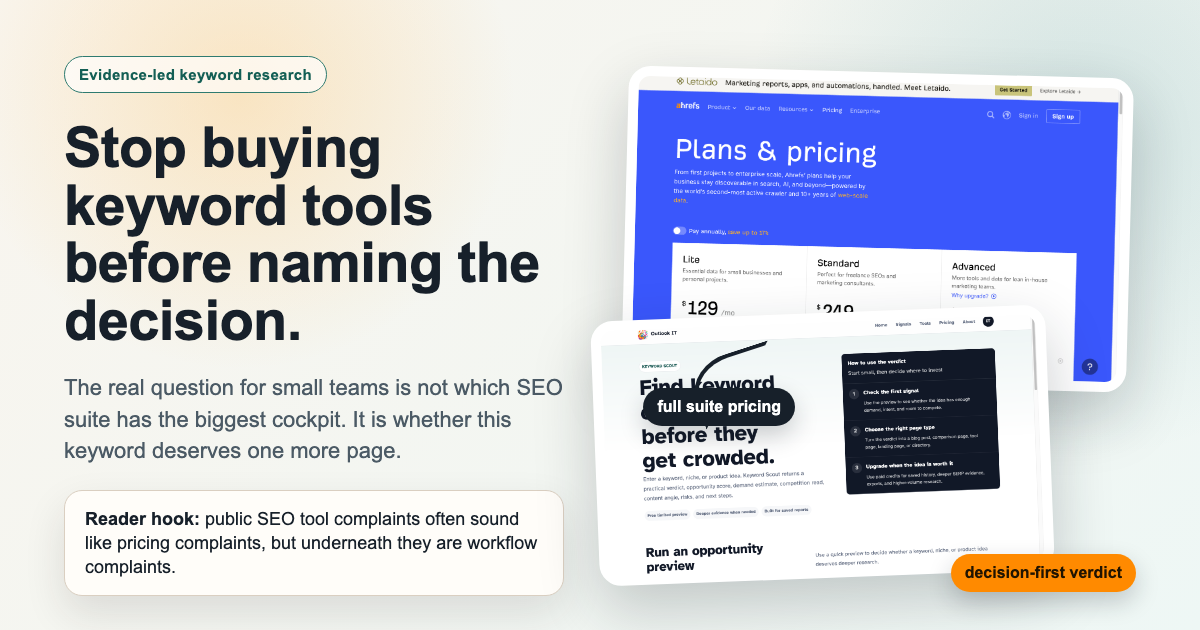
The Keyword Tool Problem Reddit Keeps Pointing To
A practical way for small teams to decide whether they need a full SEO suite, free keyword tools, or a decision-first workflow like Keyword Scout.
Read insight
Niche Site Ideas: Test the Reader, Cluster, and Utility Before You Build
A practical method for testing whether a niche site has a real reader problem, a defensible content cluster, useful evidence, and a sustainable path beyond traffic.
Read insight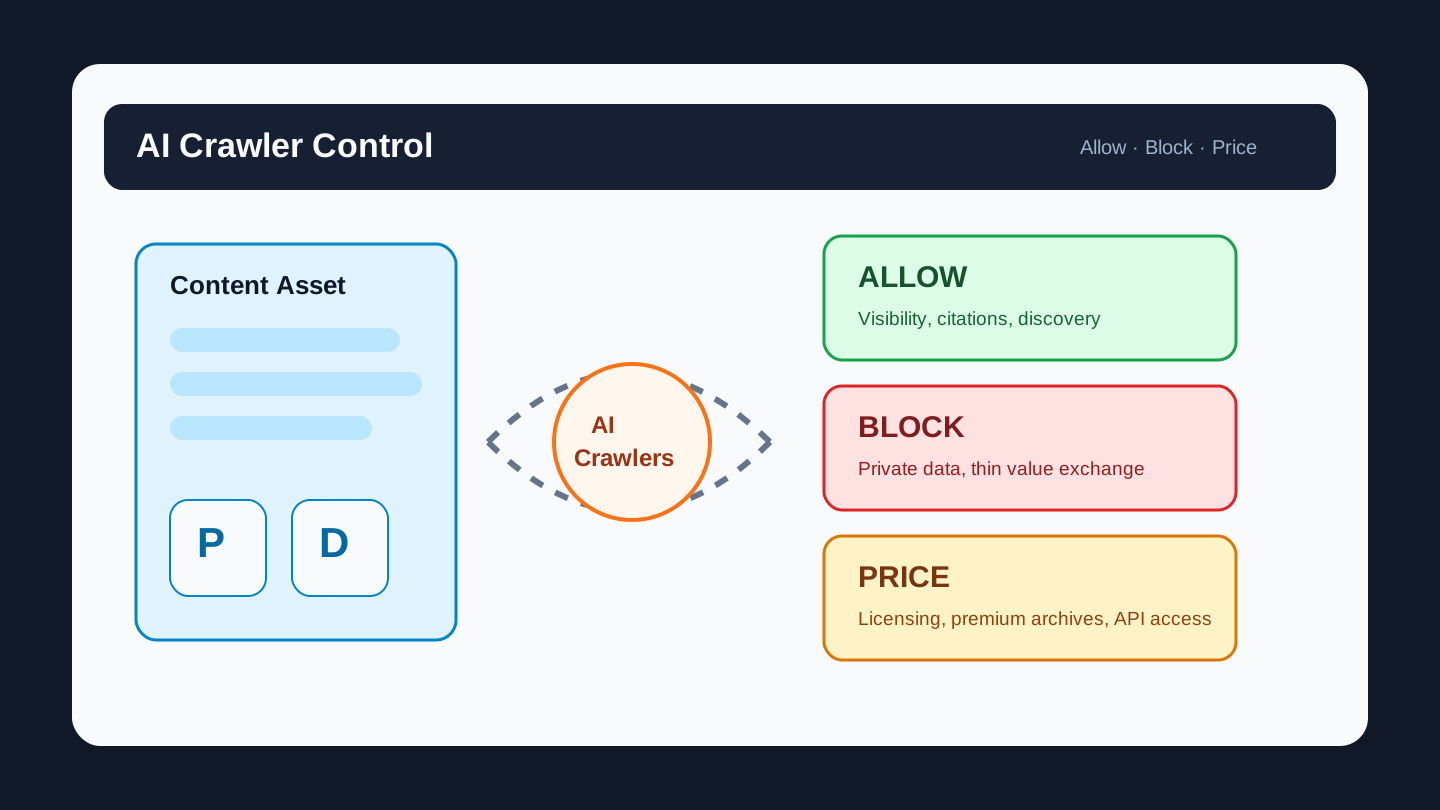
AI Crawler Control: Should Content Sites Block, Allow, or Price AI Bots?
A practical decision framework for content sites deciding whether to allow, block, monitor, or price AI crawler access.
Read insight